I thought of you today. I know how much you like the sun to warm you. Perhaps that’s why. You would have liked it by the sea, sun streaming down, a gentle breeze to caress your face.
Your hair would have been tied back. Gentle drops of perspiration would lie on your forehead.
Two days here have left me well-rested and ready for another leg of the trip, this time to La Paz. It’s an uneventful day with temperatures in the 70 to 80 degree range again. I fueled at Ciudad Constitucion and rolled into the outskirts of La Paz. I was surprised to find fuel on the north end, but in fact the entire entrance to the city has changed since my 2001 trip. It’s all four lane divided highway now, very modern and nice to drive. The little roadside taquerias have all but disappeared on the west end. I missed eating there on the way into the city.
Entrance to La Paz
La Paz is a modern city by Baja standards, with all the amenities you can think of. Yes, it’s Mexican, but that’s part of the flavor not to be missed. I much prefer it to any other place on the Baja, and it bears exploring.
I was lucky to get a room at the Los Arcos Cabanas for the night. The Los Arcos is right on the malecon, and from the bar you can watch the people on the street while overlooking the ocean bay. It’s an easy walk to restaurants and bars on the malecon, and the night life can be pretty active. I settled for a shrimp dinner and a beer and watched the action on the malecon while eating.
I’ll sleep in tomorrow, since it’s a short ride south to the tip.
I had a morning meeting with myself and decided that I’d ride all the way to Loreto today, a trip of only 409 miles (659 km). On normal roads that wouldn’t be a difficult endeavor, but with this narrow Baja road, and the corners and hills farther south, I wasn’t so sure. No sightseeing today.
Twilight came at 0530 and I hit the road at 6. Just south of the La Pinta driveway was the first vado I had ever seen with running water in it. Since it hadn’t rained here, I wondered why the vado was full. I crossed carefully with no problem — the water was only an inch deep.
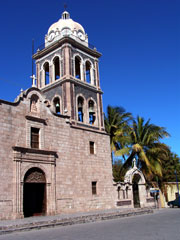
Our Lady of Loreto Mission Church
Guererro Negro was my next stop for fuel, but before that the highway again meets up with the Pacific side of the peninsula, and the cold air and thick-as-pea-soup fog I encountered cut to the bone. I had to stop and put on my rain pants to keep from getting chilled. At Guererro Negro I also lost an hour, as the time zone switches to Mountain here.
I stopped for fuel again in San Ignacio. I was going to spend the night here before proceeding on down to Loreto, but instead rode on to Mulegé for more fuel. Mulegé is a bit of a pain with it’s one-way streets, but there is a Pemex in town.
By now it’s up to 80 degrees again – a little warm to be in town, but not so bad out on the road. On the way out I discovered a new Pemex about four miles south of the town on the highway. Oh well.
North of Santa Rosalia, the road descends from the hills in a twisting downward spiral. Unbeknownst to me, a semi had stalled up-hill in the left lane on a blind corner. Fortunately I wasn’t going very fast, so I missed the line of semis that had already passed it in my lane. Just another reason for not speeding on this road even though it is good enough for high speed riding.
Inn at Loreto Bay
Finally Loreto came into view, but I passed it by for the Inn at Loreto Bay. This was a great place to relax for a couple of days and eat something besides the local food I had been devouring.
I have stopped.
One thousand miles.
I have come to rest by the sea. I keep returning but I’m not sure why any more. Wind. Waves. Smell. Sky. Sun. Sand. Sounds.
It’s not the real sea. This is the Sea or Cortez. The Golfo California. And I am just outside of Loreto, Baja California Sur. Temperatures are in the mid-80s, although the nights and mornings are much cooler.
The road was good. Two days of hard riding in daylight only, for to ride the M1 at night would be cheating death. Cattle, trucks, cars, animals of all kinds litter the roadway at unexpected times.
I measure the days thus: a three dog day yesterday; a seven dog day today, for they always seem to be laying dead in the roadway. Pups perhaps, who haven’t yet learned to grow old in traffic and now never will.
After a continental breakfast just up the street from the Hotel Bahia, I walked back, checked out and got my five dollars back on the key deposit. I pushed out early from the bar in back of the hotel and rode Avenue Lopez Mateos south to the highway. There are plenty of Pemex stations on the way south out of the city, and no shortage of fuel. Traffic is hectic, but that’s the same in any city.
I took a side trip to the end of the winding road at La Bufadora. The ride was interesting, but I didn’t feel like paying for parking in the tourist trap town. The vendor stalls weren’t open yet, but I could tell by the number of them that this place was popular with the tourists. I turned around and rode back the way I came.
Every town on the road south is dusty. If there’s a wind, there are dust devils. If the town is large enough, businesses line the highway fifty or a hundred feet back. Cars struggle to scramble over the edge of the pavement to get to them. In towns, topes or speed bumps slow and interrupt the flow of traffic, so watch out. Many aren’t well marked. Hitting one of these and speed will launch you high into the air if you’re not careful.
After fueling in El Rosario, the last town on the Pacific side of the Baja, the road turns inland away from the Pacific. It was only 54F (12C) when I pulled out of Ensenada at sunrise, and it didn’t warm up until the road traveled farther inland, finally making 80F (26C) by the time I hit Catavina and the La Pinta Hotel there. The La Pinta chain has hotels in Ensenada, San Quintin, Catavina, Guererro Negro, San Ignacio and Loreto, each complete with restaurants and bars. They’re pretty nice places to stay given that they’ve been around since the highway was completed in 1973.
Catavina
The Pemex beside the La Pinta in Catavina was closed (as it was during my ride in 2001) but I was told that it was “open last month”. Never fear though, there’s always a privateer wanting to make a little cash, and just 100 feet away was someone selling gas out of a drum for 35 pesos a gallon. He was even wearing a Harley t-shirt!
For comic relief I started up a conversation with a disheveled gringo who was hanging around the gas stop. He informed me that he had been the inventor of a well-known chocolate treat – “Reeses Pieces” but with jam rather than peanut butter, if you can believe it. His story was that he had been cheated out of millions when the peanut butter treat came on the market. I gave him 10 pesos for his story and he was happy to go away.
The hotel bar had Sol, so I was happy. I sat back and relaxed and had a couple of cold ones before dinner. A group of bikers arrived and joined me in the bar. They were waiting for some friends who had left after them, and would be arriving after dark. I didn’t envy those after-dark arrivals in the slightest.
I retreated to the restaurant for a very nicely prepared spaghetti and chicken dinner. It was excellent. I retired early and slept like a log.
Avoid at all costs the ‘direct line’ phone booths where they want your credit card for a call. Instead, buy a Ladatel or Telmex card in 30, 50 or 100 peso amounts. These phone cards can be found in the small stores up and down the shopping districts. If one store is out of them, another will have them. Sometimes there’s even bonus minutes added the first time you use the card. The Ladatel/Telmex phone booths are found almost everywhere in the Baja. (Although not in Catavina.)
Insert your card, wait for the prompt which shows how much is left on the card, and punch in 001 + area code + phone number to call any number in North America. After you hang up, that beeping noise is to remind you to remove the card.
It started out uneventful enough, but no, as luck would have it I had to ride over to Yuma to pick up a part. Nothing serious, just a delay in the proceedings until the next day.
Once across the line into Mexicali a brief stop was required to get my tourist visa (ask for 180 days, and make it the standard in case they offer less). That’s a simple form fillout that the girl did for me. She asked for my passport, and kept it as she sent me across the road to the Banjercito office to pay the bill. I brought the receipt back, she stamped my passport and handed it back to me complete with my tourist permit. I was on my way.
No vehicle permit is required for crossing into and riding down the Baja. You will need one for the mainland, should you choose to cross there.
Once into Mexicali, it’s a matter of paying attention to the road signs. Believe me, pay attention. There are two M2 routes. The first is the old two lane ‘free’ highway, and the second is the M2 divided toll road. This second road out of town is a bit hard to follow given the lack of noticeable road signs. I had to backtrack a couple of times because the signs were hidden or pointing in the wrong direction, most notably at a traffic circle to the west of city center.
Once out of town to the west, things pick up. The four lane M2 is good, but watch out for slippery spots. Anti-freeze, oil and other unknown substances seem to leak out here and there. Once on a corner hill I felt my rear tire give up traction for a split second. Had I been speeding, I could have ended up in the ditch, I’m sure.
Traffic appeared to be very light on this road, probably because of the toll.
This road winds and twists and climbs to the west and then descends all the way to Tecate, where I had to go a fair distance into town for fuel. On the way back out, make a right turn at the fire station buildings and you’ll be on your way to Ensenada via M3.
While good, this road is a narrow two lanes and drops off spectacularly on the sides. There’s lots of truck traffic too, so take care. And, in case you’re wondering, yes, people do pass on corners and hills even though they aren’t able to see oncoming traffic. Keep an eye out and corner appropriately, no matter what, on this narrow road. Because I did that, I narrowly missed a head-on with a car passing on a hilly turn.
At El Sauzal the M3 runs into M1, and before you know it you’re on the outskirts of Ensenada. Keep to the right, read the signs, and you’ll be at a Pemex station if you want to get fuel here. If not, don’t worry, because there are plenty of Pemex stations on the way out of town to the south.
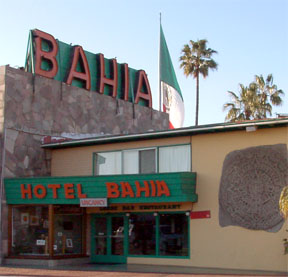
Hotel Bahia, Ensenada, Mexico
I elected to hook up with Avenue Lopez Mateos and park in front of the Hotel Bahia. It’s an older two storey hotel right downtown, with plenty of places to eat nearby. I had phoned ahead and booked a room. Price quoted — U$59.00. Price negotiated on the phone — U$39.00. During check-in I got a ticket for a free margarita in their bar. I enjoyed that after a long day in the saddle, believe me.
Parking at the hotel is in back, but the desk attendant told me I could park right beside the outdoor bar, so I wheeled up to within about 20 feet of the hotel’s back door, parked for the night and unloaded.
The room wasn’t anything fancy, but it did have a small balcony overlooking the sea to the west. You have a choice of carpeted rooms upstairs, or no carpet downstairs. And, they offered a ticket to a continental breakfast in the morning at a restaurant just a couple of doors away. The Hotel Bahia is popular with the biker crowd, so be aware that during rallies you may not be able to get a room here.
Hussong’s and everything else is within a short walk, so see the sights and try to avoid buying trinkets, because if you’re headed south, it’s a long way to be hauling goodies for the folks back home.
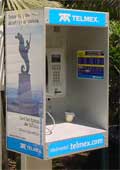 Avoid at all costs the ‘direct line’ phone booths where they want your credit card for a call. Instead, buy a Ladatel or
 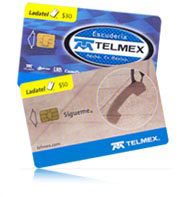 Insert your card, wait for the prompt which shows how much is left on the card, and punch in 001 + area code + phone number to call any number in North America. After you hang up, that beeping noise is to remind you to remove the card.